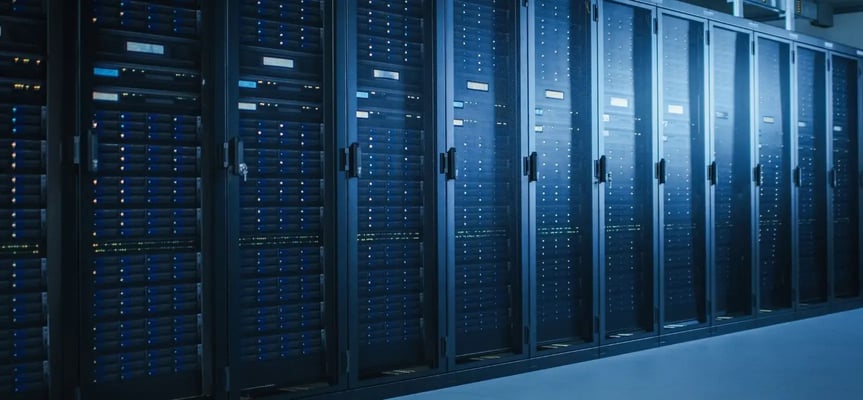
An AI data center may look like a conventional facility from the outside. Inside, however, the engineering requirements are changing quickly.
As AI workloads grow, more computing power is packed into fewer racks. This increases electricity demand while also generating more heat that the facility must continuously remove.
The challenge is no longer limited to server capacity. AI data center power consumption, electrical infrastructure, cooling capacity, and thermal management now need to be considered together.
Why AI Is Changing Data Center Infrastructure
Higher-performance GPUs and computing hardware can require significantly more power within the same rack footprint. This affects electrical capacity, cooling requirements, equipment space, and supporting infrastructure.
Higher AI Workloads Mean Higher Rack Density
Higher rack density concentrates more power and heat in a given area.
For engineers, this makes AI data center design an exercise in determining how much power, cooling, space, and supporting infrastructure the facility needs for its expected IT load.
Why More Power Creates More Heat
The relationship is straightforward:
Higher Computing Load → Higher Electrical Load → More Heat → Greater Cooling Demand
The resulting heat needs to be removed continuously, making cooling an important part of early facility planning.
The Growing Power Challenge
Rising AI Data Center Power Consumption
AI data center power consumption is becoming an important consideration for data center developers and utilities.
A recent Reuters report highlighted this connection through NextEra Energy's planned restart of the Duane Arnold nuclear plant in Iowa. The 615 MW facility is supported by a U.S. Department of Energy loan commitment of up to $1.9 billion and is expected to resume operations in 2029, subject to regulatory approvals.
The development illustrates how meeting growing data center demand can involve power generation as well as facility-level electrical infrastructure.
Power Distribution and Grid Capacity
High-density facilities require more than a larger utility connection. Engineers may need to evaluate transformers, switchgear, UPS systems, distribution equipment, backup generation, and available utility capacity.
A well-planned data center power distribution system needs to deliver reliable power to IT equipment while accounting for the facility's other electrical loads.
Site selection also needs to consider utility capacity, transmission infrastructure, and interconnection timelines.
Why Cooling Is Becoming a Bottleneck
Almost all electricity consumed by computing equipment eventually becomes heat. Higher rack densities can therefore place greater demands on the facility's cooling infrastructure.
Data Center HVAC and Thermal Management
A properly engineered data center HVAC system needs to account for IT loads, rack density, airflow, equipment placement, environmental conditions, and heat rejection.
Data center HVAC design becomes more complex when higher-density equipment changes airflow patterns or requires different cooling approaches.
Data center thermal management also involves monitoring temperature, airflow, and equipment conditions to maintain suitable operating environments.
Liquid Cooling for High-Density AI Data Centers
Liquid cooling is becoming an important option for high-density AI infrastructure.
Direct-to-chip cooling transfers heat from components such as GPUs and CPUs through liquid-cooled plates. It introduces requirements for piping, pumps, heat exchangers, controls, and heat rejection.
Data center immersion cooling uses a non-conductive fluid to absorb heat from computing hardware. This changes equipment layouts and introduces considerations around tanks, fluid management, maintenance, and heat rejection.
Liquid cooling systems for data centers can therefore affect both mechanical infrastructure and available equipment space.
| Approach | Heat Removal | Key Considerations |
|---|---|---|
| Air cooling | Conditioned air | Airflow, HVAC capacity |
| Direct-to-chip cooling | Liquid at components | Piping, pumps, CDUs |
| Immersion cooling | Non-conductive fluid | Tanks, fluid management |
The appropriate solution depends on rack density, IT equipment, facility design, utilities, and operating requirements.
Planning an AI or High-Density Data Center Project?
Contact Nearby Engineers to discuss your data center HVAC, electrical, BIM, CFD, and broader MEP engineering requirements.

MEP Considerations for AI Data Centers
Data center HVAC design needs to address the expected IT load and selected cooling approach. Electrical engineering must cover service capacity, transformers, UPS systems, distribution, and backup power.
Where liquid cooling is used, additional requirements may include piping, pumps, heat exchangers, leak detection, and maintenance access.
BIM and CFD can help engineers coordinate equipment and evaluate airflow and temperature distribution before construction.
For high-density facilities, data center MEP design brings these requirements together within the overall building design.
Planning for Future AI Workloads
AI hardware and workloads will continue to evolve. Engineering teams should therefore consider how the facility can accommodate changes in computing requirements.
A practical design sequence is:
Define IT Load → Assess Power Availability → Establish Rack Density → Select Cooling Strategy → Design MEP Systems → Coordinate BIM/CFD → Review Future Capacity
Planning these requirements early can reduce major design changes during later expansion.
How Nearby Engineers Supports Data Center MEP Design
Nearby Engineers provides MEP engineering services across HVAC, electrical, plumbing, fire protection, BIM, energy modeling, and CFD analysis.
For data center projects, its capabilities support the relationship between IT loads, electrical requirements, data center HVAC, equipment layouts, and supporting infrastructure.
Its data center MEP approach can help project teams evaluate these requirements as part of one coordinated engineering process.
Conclusion
AI is changing the engineering requirements of modern data centers. Higher computing density is increasing power demand and heat loads, while liquid cooling technologies are introducing new mechanical requirements.
The key is to evaluate power, cooling, equipment density, and supporting infrastructure early in the design process.