

High-Head Single Stage Vertical Fire Pump Selection Guide for Commercial Retrofit
1. Introduction: Why Pump Selection Matters More Than Ever
Across the United States, many commercial buildings — light industrial parks, mid-rise office towers, and mixed-use complexes — still operate fire suppression systems engineered 20 or more years ago, often around municipal water pressures that have since declined or occupancy loads that have fundamentally changed. Retrofitting with a right-sized pump is no longer optional; it is a code-driven, liability-reducing necessity.
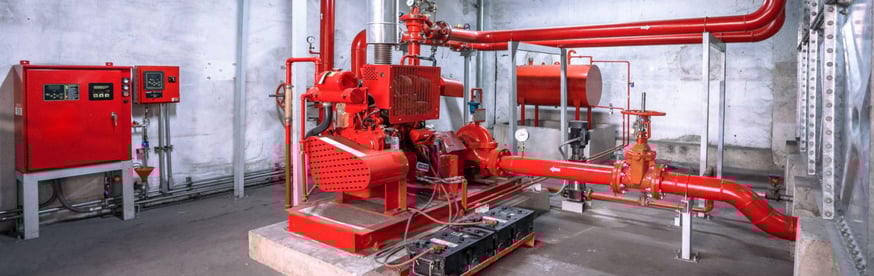
The vertical single-stage centrifugal fire pump has become the preferred retrofit solution: its vertical shaft design requires 40–60% less floor space than a horizontal split-case equivalent, simplifies drain piping, and reduces installation labor — all critical advantages in occupied buildings. This guide walks MEP engineers and facility managers through a five-step selection process covering flow, head, power compatibility, impeller material, and NFPA 20 compliance, with a full comparison table from 2 HP to 50 HP.
2. Commercial & Industrial Application Scenarios
Before sizing a pump, it is essential to match the application profile to the correct pump class. The three most common commercial scenarios in the U.S. market present distinct engineering demands:
Scenario A: Light Industrial Warehouses & Distribution Centers
These facilities typically use ESFR sprinkler heads across wide open floor plates. Key concerns are corrosion resistance from variable water quality and low-noise operation near production zones. Pumps at 25 HP and above with stainless steel impellers are often preferred.
Scenario B: Mid-Rise Office & Mixed-Use Commercial
Buildings in the 5-15 story range face a familiar pressure deficit: municipal supply is adequate on lower floors but insufficient at upper levels. A pump delivering 80 to 128 meters of head while maintaining stable flow across a wide pressure curve is typically required. The 30-50 HP class covers this range effectively.
Scenario C: High-Rise Urban & Sewage System Integration
High-rise and sewage-integrated systems demand sustained thermal performance and mechanical reliability under continuous duty. Specify pumps with reinforced heat-dissipation enclosures and precision-balanced rotors; the 40-50 HP range is most commonly applied here.
3. Five-Step Selection Checklist with Full Comparison Table
Use the following structured approach before specifying any pump. Each step eliminates unsuitable models and narrows the selection to two or three viable candidates.
Step 1 — Establish System Demand Flow (GPM)
Pull the hydraulic calculation from the sprinkler system design. If the system is being retrofit, re-run calculations per NFPA 13 using current occupancy and storage configurations. The pump's rated flow must meet or exceed the design demand at the required residual pressure.
Step 2 — Calculate Required Head (Meters or PSI)
Required head = static lift + friction losses in supply piping + residual pressure requirement at the highest/most remote head. For buildings above five stories, required head typically exceeds 47 meters; buildings above 10 stories often require 100+ meters of head. Never derate: select a pump whose rated head at design flow has a minimum 10% safety margin.
Step 3 — Confirm Available Electrical Supply
This is the most common compatibility gap in U.S. retrofit projects. Pumps rated for 380V three-phase (common in export-specification equipment) require a step-up transformer or a compatible 480V supply with appropriate adaptation when installed in buildings served by standard U.S. 208V or 240V commercial distribution. Always verify the facility's available voltage before specifying a pump — particularly for units in the 25 HP and above range.
Step 4 — Select Impeller Material Based on Water Quality
For systems supplied by municipal water with standard chlorination, cast iron impellers are acceptable in low-to-mid pressure applications. For systems with higher mineral content, recycled water, or in corrosive coastal environments, stainless steel impellers are strongly recommended. All pumps in the 3 HP (2.2 kW) class and above should include stainless steel impellers as a baseline specification.
Step 5 — Verify Thermal & Mechanical Design for Duty Cycle
Fire pumps are rated for intermittent duty, but in booster and pressure maintenance roles, run time can be substantially longer. For these applications, specify pumps with all-copper coil motors and precision-balanced rotors. For the 40 HP and above class, confirm that the motor enclosure includes reinforced heat-dissipation features sufficient for the expected ambient and duty conditions.
Typical Head Ranges for Single-Stage Vertical Fire Pumps
(Market Reference for Preliminary Sizing – Add Minimum 10% Safety Margin)
| Power Range (HP) | Typical Rated Head Range (meters) | Typical Rated Head Range (PSI) | Common Retrofit Applications | Notes for Engineers |
|---|---|---|---|---|
| 15 – 20 HP | 40 – 60 m | 55 – 85 PSI | Mid-rise commercial (5–8 stories), light industrial | Suitable for moderate pressure boost |
| 25 – 30 HP | 60 – 100 m | 85 – 140 PSI | Mid-rise office/mixed-use (8–12 stories) | Good for corrosion-prone water sources |
| 40 HP | 80 – 110 m | 110 – 155 PSI | Higher mid-rise or buildings with high friction losses | Enhanced thermal management often needed |
| 50 HP | 100 – 130+ m | 140 – 185+ PSI | High-rise zones or tall commercial structures | Higher rotational speeds common (up to ~2900 RPM) |
When matching these typical head ranges to real-world projects, many MEP engineers evaluate options from various suppliers that offer single-stage centrifugal fire pumps featuring stainless steel impellers (for improved corrosion resistance in Scenarios A and B), reinforced heat-dissipation designs (particularly useful in Scenario C), and all-copper coil motors. Models in the 30–50 HP range capable of delivering 100–130 m head are frequently considered for mid-to-high rise commercial retrofits, especially where space is constrained and faster installation is a priority.
4. Why Vertical Single-Stage Outperforms Horizontal Split-Case in Retrofit Scenarios
For retrofit projects inside occupied commercial buildings, the vertical single-stage configuration delivers measurable advantages across three dimensions:
- Space: Vertical units require 30–50 sq ft versus 80–120 sq ft for a horizontal split-case equivalent — a 40–60% reduction that frequently eliminates the need for mechanical room expansion or structural modification.
- Installation Speed: Direct riser connection without suction/discharge elbow assemblies reduces installation time by an estimated 30–40% and eliminates custom pipe fabrication.
- Maintenance: All-copper coil motors exhibit lower fault rates under thermal cycling than aluminum-wound equivalents. Stainless steel impellers extend service life to 15+ years in standard municipal water conditions, and the vertical shaft design allows mechanical seal access without disturbing pump-to-motor alignment.
5. Electrical Compatibility & NFPA 20 Considerations
Electrical Compatibility — The 380V Issue in U.S. Projects
Pumps in the 25 HP and above range are commonly rated for 380V three-phase supply. Before specifying, confirm the facility's available voltage (typically 208V, 240V, or 480V in U.S. commercial buildings) and factor in a step-up transformer or a 460/480V motor winding option where required. This single compatibility check prevents the most common retrofit delay.
NFPA 20 Compliance Scope
NFPA 20 governs fire pumps installed as the primary pressure source for sprinkler and standpipe systems — these applications require a fully listed pump, driver, and controller assembly. Vertical single-stage centrifugal pumps are well-suited to pressure maintenance and booster roles, where NFPA 20 listing requirements may differ. Always confirm the applicable scope with the Authority Having Jurisdiction (AHJ) early in the design process, as compliance requirements vary by project type and local adoption of the standard.
6. Conclusion
The right vertical single-stage pump is not the largest or most expensive — it is the one whose head curve, flow rating, impeller material, thermal design, and electrical compatibility collectively match the building's actual demand profile with appropriate safety margins.
For MEP engineers working under compressed project timelines, this configuration offers a compelling combination of installation efficiency, long-term maintenance simplicity, and favorable total cost of ownership — making it a logical default consideration for commercial fire protection upgrades. Engineers are encouraged to cross-reference manufacturer performance curves and consult with the AHJ for project-specific compliance requirements before final specification.

Ankit Javeri
Ankit is the Project Manager at NY Engineers, who holds an M.Tech. Some of his projects includes Community Access, Jackson Avenue
Discuss Your Project With Our Engineers

Join 15,000+ Fellow Architects and Contractors
Get expert engineering tips straight to your inbox. Subscribe to the NY Engineers Blog below.